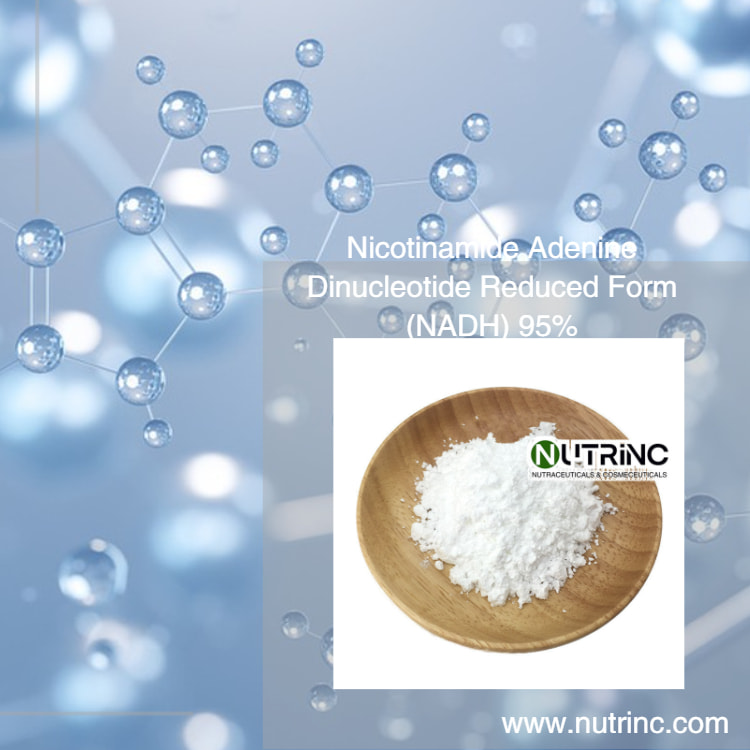
Nicotinamide adenine dinucleotide (NADH)
It is a chemical substance that is a reduced form of nicotinamide adenine dinucleotide, reduced to coenzyme I. N stands for nicotinamide, A for adenine, and D for dinucleotide.
NADH is produced by the citric acid cycle in glycolysis and cell respiration. The NADH molecule is a controlling marker in the energy production chain in mitochondria.

Function of Diphosphopyridinenucleotide reduced form (NADH)
1. Effect on skin
Whitening effect: nicotinamide adenine dinucleotide can inhibit the formation and transport of melanin, so as to play a whitening effect and help maintain normal skin function.
2. Effect on growth and development
Promote growth and development: It can participate in the synthesis of coenzyme I and Coenzyme II in the body, and then play a role in promoting growth and development.
3. Effect on vision
Maintenance of normal vision: This substance is converted into retinoic acid in the body and can be used as a photosensitive substance to help maintain normal vision.
4. The effect on the body's immunity
Enhance body immunity: nicotinamide adenine dinucleotide can regulate the function of immune cells, improve the body's resistance to disease, and achieve the purpose of enhancing body immunity.
5. Effect on energy metabolism
Improve energy metabolism: It can promote fat decomposition, increase the body's heat production, and help improve the abnormal situation of energy metabolism.
6. Role in cell-related activities
Participation in cell metabolism: nicotinamide adenine dinucleotide is involved in a variety of physiological activities such as cell metabolism, energy synthesis, cell DNA repair, and plays an important role in the body's immune capacity. In a healthy state, the concentration of nicotinamide adenine dinucleotide in the human body is stable, and the normal function of all cells is maintained.
7. Cell signaling:
As an important molecule of cell signal transduction, it plays an important role in some cell signal transduction and transcriptional regulation.
8. Role in metabolic reactions
As a REDOX coenzyme: It is a REDOX coenzyme that can participate in intracellular REDOX reactions, regulating the REDOX balance in cells by accepting or releasing electrons, so as to maintain normal metabolic function.
Participating in glucose metabolism: Participating in multiple links of glucose metabolism, such as glycolysis, tricarboxylic acid cycle and allogluconeogenesis, is one of the important coenzymes in glucose metabolism.
Participate in fatty acid metabolism: Participate in fatty acid synthesis and β-oxidation and other processes, is one of the important coenzymes to maintain the balance of fat metabolism.
Participating in amino acid metabolism: Participating in the process of amino acid metabolism, such as glutamate-alanine transfer, alanine-threonine transfer, etc., helps to maintain the balance of nitrogen metabolism.
9. Effects on the kidneys and pain
Kidney protection: It has a protective effect on renal infarction caused by ischemic surgery, and can significantly reduce the levels of serum urea nitrogen and creatinine; It has protective effect on renal tubule injury caused by ischemic surgery, and has important application value in preparing drugs for preventing and treating renal ischemic injury.
Relief of inflammatory pain: With certain application in the preparation of drugs for inflammatory pain, the deacetylases SIRT1 and SIRT2 rely on nicotinamide adenine dinucleotides (NAD +) are involved in the regulation of inflammatory pain induced by formalin and complete Freudean adjuvant (CFA), while SIRT1 and SIRT2 participate in the inhibitory effect of NAD + on inflammatory pain through different mechanisms, Thus, it has analgesic effect on inflammatory pain