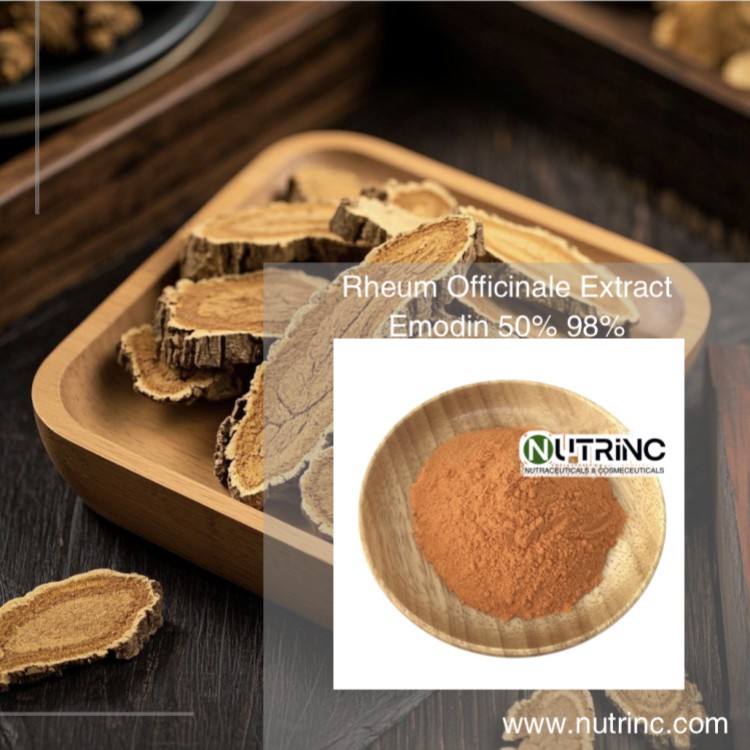
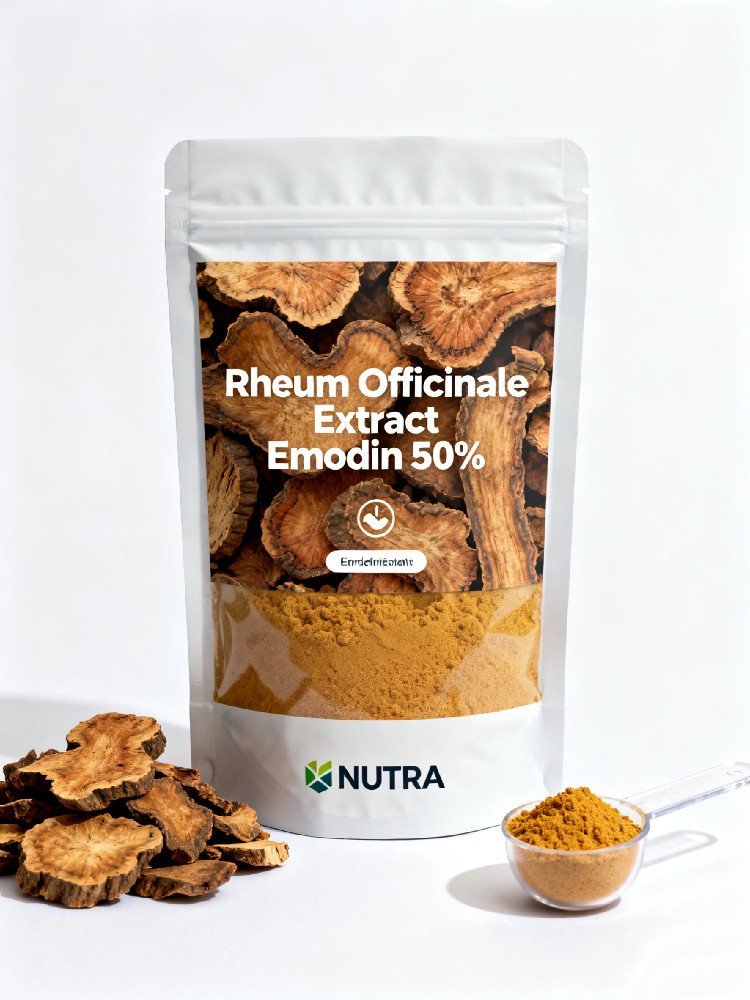
Rheum Officinale Extract Emodin 50% 98%
Emodin is widely present in a variety of plants, such as polygonaceae plants palmatophyllum,
Tanggu superyellow, medicinal rhubarb rhizomes, legumes narrow leaf senna, cuspate leaf senna, liliaceae plant aloe.
These plants are the main natural sources of emodin, and emodin can be isolated from plants by solvent extraction and column chromatography.
Emodin
CAS number 518-82-1
Molecular weight 270.237
Density 1.6±0.1 g/cm3
Boiling point 586.9±39.0 °C at 760 mmHg
Molecular formula C15H10O5
Melting point 255 °C (dec.)(lit.)
Physiological activity and effect
1.Antibacterial and anti-inflammatory:
It has an inhibitory effect on a variety of bacteria and fungi, such as Staphylococcus aureus, Escherichia coli, Candida albicans, etc.
The mechanism may be through inhibiting the synthesis of bacterial cell wall and interfering with bacterial metabolism.
At the same time, emodin can also inhibit the release of inflammatory mediators and reduce inflammatory response.
2.Anti-tumor:
It has been found that emodin can inhibit proliferation and induce apoptosis of various tumor cells.
It can block the growth and proliferation signaling of tumor cells by regulating the signaling pathway of tumor cells,
such as inhibiting the PI3K-AKT signaling pathway.
It can also induce tumor cell cycle arrest, so that tumor cells are stagnated in the G0/G1 phase, thus inhibiting tumor cell division.
3.Antioxidant:
Emodin has strong antioxidant capacity and can remove free radicals in the body, such as superoxide anion free radicals, hydroxyl free radicals and so on.
It can provide hydrogen atoms or electrons, combine with free radicals, make them inactive, reduce the damage of free radicals to cells,
and thus play an anti-oxidation and anti-aging role.
4.Liver and gallbladder protection:
It has a protective effect on the liver and can reduce the damage of chemicals and drugs to the liver.
It can promote bile secretion, increase bile flow, facilitate bile excretion, thereby reducing cholestasis, cholecystitis,
gallstones and other diseases have a certain preventive and therapeutic effect.
5.Other functions:
Emodin also has the effect of lowering blood lipids, lowering blood sugar and improving renal function. In the aspect of lowering blood lipids,
it can inhibit the differentiation of fat cells and lipid accumulation; In terms of lowering blood sugar,
it can improve insulin sensitivity and promote the uptake and utilization of glucose.
Application field
1.Medical field:
Emodin can be used as a raw material for the development of drugs for the treatment of tumors, inflammation, infection and other diseases. At the same time,
it is also an important active ingredient in some traditional Chinese medicine preparations, such as rhubarb preparations,
which are often used in clinical treatment of constipation, jaundice and other diseases.
2.Health care products:
Because of its antioxidant, anti-aging and other effects, emodin is used in health care products, can be made into capsules,
tablets and other forms to help people prevent diseases and delay aging.
3.Cosmetics field:
Using the antioxidant and antibacterial effects of emodin, it can be added to cosmetics, such as skin care products, shampoos, etc.,
can play an antioxidant, anti-inflammatory, antibacterial effect, and help protect the health of skin and hair.
4.In the agricultural sector:
Emodin has repellent and inhibitory effects on some crop pests,
and can be used as a natural pesticide component for the prevention and control of crop diseases and pests,
reducing the use of chemical pesticides.